
OP-ED - An engineer and his team of AI agents have a quarrel with your bank card
Part three of three on Francois Rautenbach, an engineer using AI to do the work of five while making the case for a way to pay that hangs on proof rather than trust.


Francois Rautenbach spent this past weekend running a software qualification pass. That's effectively the grinding final stage where you test, fix, test again, until what you're building hums.
More accurately, though, he spent most of his time overseeing AI agents that he's deployed to check his work. Curiously, he says his agents just turned up two bugs in code sitting in the chip manufacturer's libraries. Reporting those to the factory is now on his to-do list for the week.
 Andile Masuku
Leading into COVID, he ran a team of five people in South Africa, each owning a slice of the workflow. Those were the hardware designer, the mobile-app developer, the firmware and the server-and-database engineer and a fintech hand who could sit with clients. Rautenbach was chief programmer, project lead and chief product officer all rolled into one, the one who "stands back a little bit and can see the whole picture" while each specialist saw only their piece.
When the pieces met in integration testing, often things wouldn't line up. Work would stall on the classic mismatch - my thing expects this, but yours is sending that - and fixing it meant a constant back-and-forth of code updates between leads. He now runs that whole "team" himself, as a sort of director of agents.
"I'm the top agent," he says, "and these are all the sub-agents doing the work for me." He talks to each one the way he once went desk to desk.
Rautenbach observes that for years the trade has increasingly leaned into an adoption trend featuring higher-level languages, more abstraction and more convenience. But he's found value in resisting the urge to embrace that wholesale. These days, with agents handling the labour, he finds himself dropping back to C, to finesse code that is smaller, more auditable and, crucially, more secure.
He offers a cautionary example. A web project built on a framework like Angular can drag in some 700 dependencies, featuring libraries written by strangers, with each pulling in more. All it takes is for one of those to be compromised and an unmaintained package to be handed off to a bad actor, for everyone using it to inherit the vulnerability. Self-contained C, written to order, goes a long way to eliminating that borrowed risk.
He argues that it's just a better way to build, even where the market offers no incentive for bothering to do so.
At Zapper, Rautenbach was the company's first full-time employee. On arrival, he was tasked with solving a single problem by the firm's well-heeled angel backer. Build something that lets a diner pay by phone and walk out, with no waiting around as the waiter faffs. While delivering on that payments solution brief, he stumbled on a bigger problem - one older and deeper. Anyone can scan a code and send money, but how does the merchant know they’ve been paid?
On Zapper’s tab, he also learned that a company fluent only in software tends to underestimate the value of hardware. He recalls being humbled as a bug patched with an upload became, in the real world, a 600-kilometre drive to a faulty device and back.
He left at the end of 2017, increasingly uneasy that the QR code at the heart of their value proposition was an unchallengeable one-way, read-only thing you simply had to trust.
Two ex-Zapper colleagues and one from Thumbzup shared that unease and joined him in co-founding AuthGate around the problem others had waved away. He calls it proof of fact, or attestation, alluding not just to can I make a claim, but can I prove it to someone who has no reason to believe me. Once you look at payments through that lens, the familiar machinery starts to look a little odd.
Tap your phone at a till, Rautenbach points out, and you aren't pushing money to the shop. You're, in fact, granting a chain of intermediaries the right to pull it from your account. That's the same structure as a debit order and the carbon-paper card slips of the 1970s, only faster. Visa, Mastercard et al and the processors behind them sit in the middle of every one of those transactions, cheerfully taking their cut for "facilitation".
In his blunt reading, Rautenbach reckons they "don't really add any value, apart from letting us pay each other." Meanwhile, the fraud the global credit card system carries (roughly USD 33 billion annually) is simply priced into the cost of doing business, underwritten by complicated insurance mechanisms and passed down until the consumer pays it in the cost of the bread you just swiped or tapped for at your local bakery.
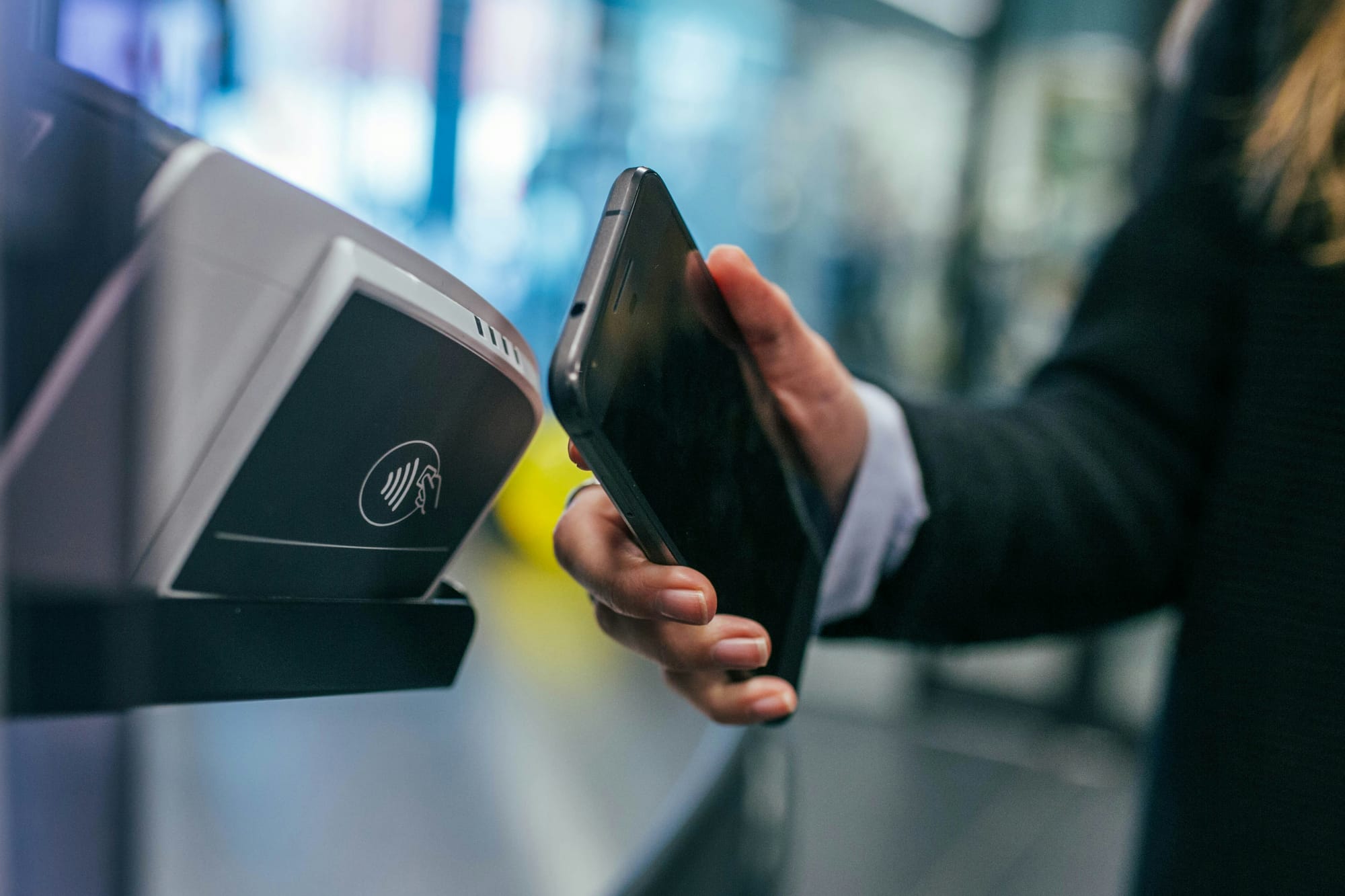
His alternative turns the hardware around. The expensive device, the phone, already sits in the customer's hand. So the merchant only needs something cheap and simple on their end to tell for a fact that payment has landed.
The team at AuthGate figured a small, battery-powered unit that lasts a year and works without internet would do very nicely. And so they built a transaction authentication device nicknamed the TAD, which, apparently, users compared to a Tamagotchi - the pocket-sized digital pet Bandai launched to global craze in the mid-90s.
At the Wakkerstroom Music Festival in 2019 they ran an early version through more than 300 live payments over a weekend of festivities to rave reviews from merchants, delighted not to have to pay as much as 3.5 per cent of the revenue to intermediaries for card payments "facilitation". Apparently, the product was also well-received by fruit sellers and car guards in Sunnyside, Pretoria, who understandably resonated with holding a device that turns green because the money is genuinely in the account - all with no card rails, no transaction fees and no middleman.
This is why Rautenbach and his wife Deirdre now live in the Netherlands, IP in tow. Europe, he says, understands the pain. It already runs Single Euro Payments Area (SEPA) instant transfers, account to account in seconds for a flat fee measured in fractions of cents, rather than a percentage that swells with the size of the sale. And Europe has grown wary of what the pain implies.
EMV, which originally stood for Europay, Mastercard and Visa, is the standard behind every chip-and-pin card. And those rails are now controlled by a consortium in which US networks hold decisive influence. A trepidation about compromised sovereignty charges Rautenbach's argument, as it's now apparent that whoever controls the switch can throw it.
When Washington sanctioned International Criminal Court officials in 2025, Visa and Mastercard blocked several ICC judges from using their bank cards, and US financial firms must block sanctioned payments even between two banks inside the EU. A starker precedent was set in 2022 when Western sanctions cut Russia's access to Visa and Mastercard and its domestic payments were immediately disrupted.
Hence the EU push for account-to-account instant payments, interoperable wallets and a digital euro to reduce its dependence on the US networks.
It’s worth noting that some analysts argue that the threat is overstated. They posit that Washington has never actually cut Europe off, as doing so would gut American commercial interests. Some even hold that protectionist measures intended to defend European payments sovereignty face formidable ideological and legal challenges, never mind an uphill battle against consumer preferences playing out within free-market contexts.
Be that as it may, Rautenbach is under no illusions about what it will take to put a dent in the wall in front of him. Displacing cards means winning a two-sided market. Every customer needs the app and every merchant needs the device. He has ideas about how to break it. Unfortunately, nothing quick, nothing easy.
 Andile Masuku
The same instinct that had him reading software off an Apollo module, and hand-writing a networking stack Novell couldn't, now has him building ways to pay that rely on proof over trust, and building it with a bunch of AI agents that a five-person team (given the same time and resource constraints) is unlikely to match.
Indeed, the answer to whether the world wants a payment it can verify over one it can conveniently, and perhaps mindlessly, assume, is one Rautenbach is hoping leans AuthGate's way.
Editorial Note: A version of this opinion editorial was first published by Business Report on 15 September 2026.