
OP-ED - The badge says "fully human"... Substack's scanner couldn't see the four AI tools I'd used.
New EU rules, a public AI detector and an invisible watermark land in a flurry.


It really did feel good to land a nod from Substack. Its new AI-detection feature scanned my latest piece for Future in the Humanities (FITH) and returned a clean bill, declaring the text AI 0%, AI-assisted 0%, Human 100%, complete with a green bar lit end to end. Analysis by Pangram, which bills itself as "the most advanced AI detection model", suggests the text was written by a human.
By my own standard, it was.
What the badge doesn't account for is my AI-augmented workflow. Fathom recorded, transcribed and archived the interviews. I conducted research and fact-checks using Perplexity and NotebookLM. And the piece was sub-edited using Claude. Fully human-written? You tell me.
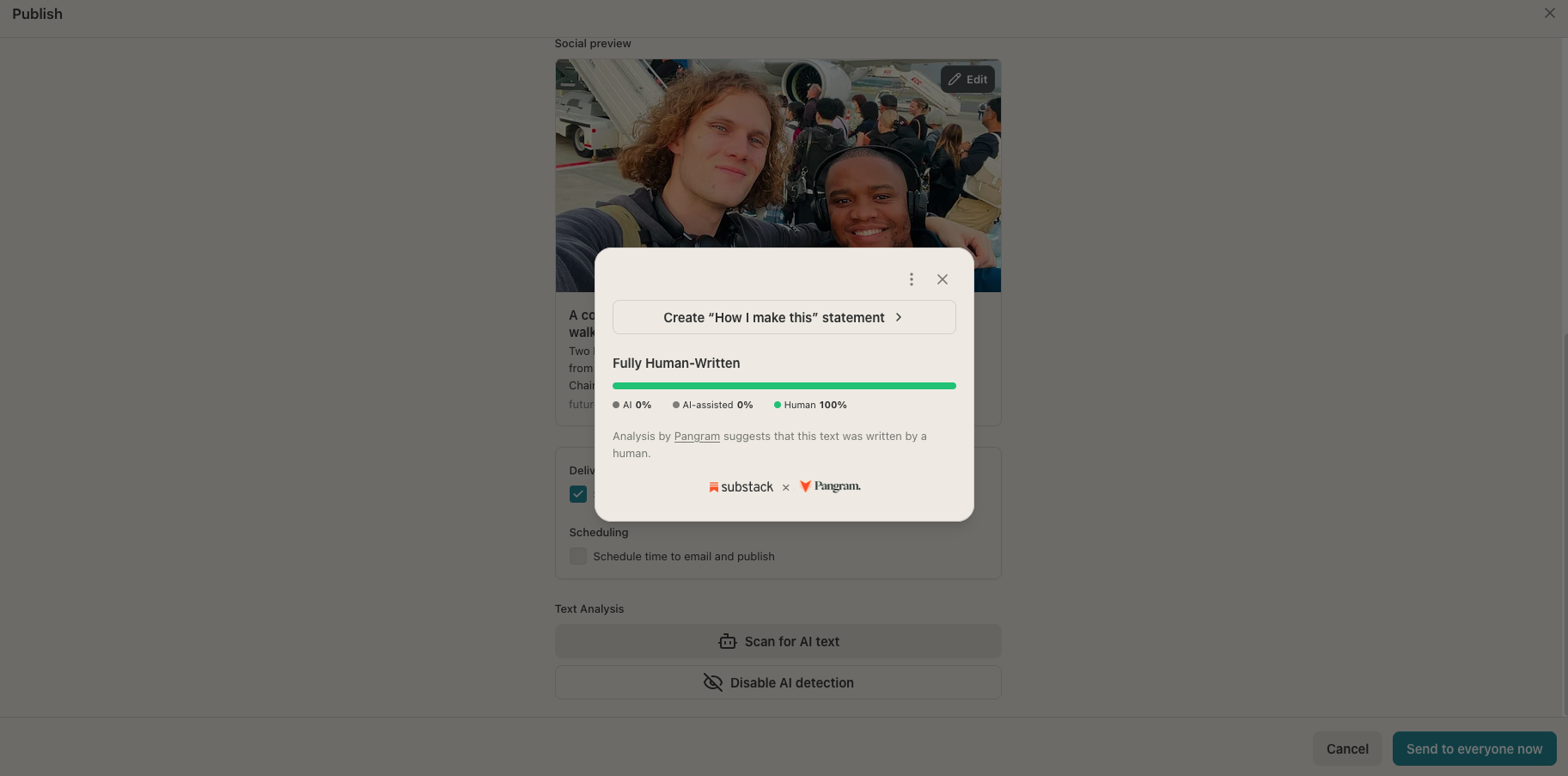
Substack's AI-detection feature went live on 21 July, letting readers scan any post above 100 words through Pangram for a human, AI-assisted or AI-generated split. A few weeks later, Anthropic said its newer Claude models would weave an invisible, machine-readable watermark into generated text, one that travels with the words even when they are copied and pasted. Anthropic's watermark answers the European Union's transparency rules, which took effect on 2 August. Substack's scanner is a separate, voluntary move.
The reaction to these developments can be broadly categorised into two buckets. One camp is celebrating that now we get to see who is authentic. The other dreads an imposing surveillance creep over the written word, for reasons ranging from the principled to the self-interested. It’s a worry stoked by content marketers' social chatter that platforms will throttle anything AI has touched, however lightly.
Both sides seem to view the rules as a purity test, a yes-or-no on whether AI touched the work. But a closer look at the substance of the European Commission's regulations suggests that's not what they're solving for.
Setting aside philosophical and ideological proclivities for a moment, Article 50(2) puts the burden on the provider, that is Anthropic and its peers, to mark what a model generates so another machine can detect it. It simply answers the question, did a model produce this?
And Article 50(4) puts a duty on the deployer, not least publishers and journalists like me, to label AI-generated text on matters of public interest, unless the work has had real human review or editorial control. Spell-checking and grammar fixes do not count. And the bar sits higher still, as the Commission's guidance holds that:
"Editorial responsibility means that a person must hold the ultimate legal responsibility over the publication of the content, including the human review or editorial control."
It appears that the law is subtler than the hubbub around it, and that, at present, the tooling deployed to comply might well be blunter than the statutes.
I will admit that the purist line gets my back up. The stricter voices hold that any AI in the loop taints the craft (that is, any creative endeavour at all), a position I find impractical and a little haughty. Past the virtue signalling, there sit concerns worth taking seriously in either direction.
One of the sharper takes I've heard recently came from two FITH fellows situated in Wits University’s SA–UK SARChI Chair in the Digital Humanities, quoted in the very piece Substack's scanner cleared as fully human.
 Andile Masuku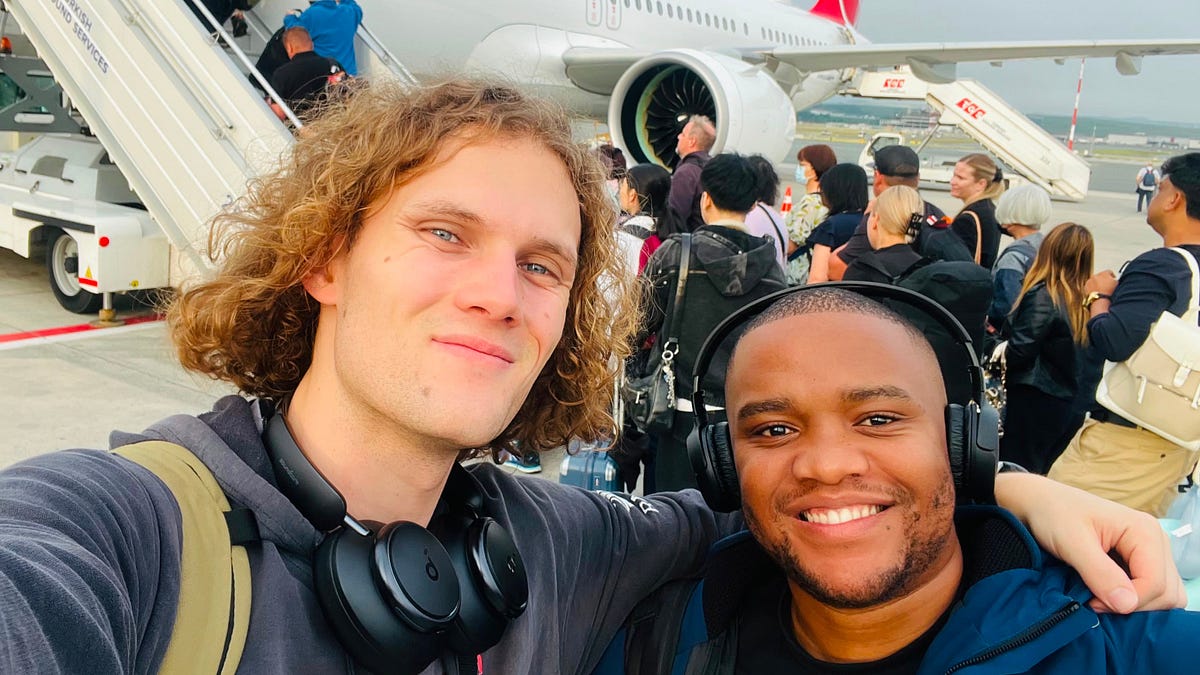
Karabo Mohapeloa, a computer scientist, noticed how differently his humanities colleagues met the tools within a research context.
"For someone coming from computer science, this randomness isn't scary, because it's all just data," he said. "But for someone that's in the humanities, this could be people's [cherished] opinions. It's not just a random data point." Max Milella, a tech-leaning linguist, pushed back on reading that as mere unease: the hesitance, he offered, is "more a scepticism over the ability to operationalise complex human behaviour into reliably quantifiable and predictable variables."
So far, my observation is that the new machinery doesn't reach the most essential parts. A badge may well certify that work bears traces of AI use in a piece of writing, but it can't speak to the active judgement of what to include, what to cut and what to check.
While I sense the burden of all this keenly, ultimately, the real cost is not mine alone to carry. Like many other professionals of my generation, I’ve built a stack of critical skills, expertise, relationships and trust earned over years before any of this landed. A younger cohort is coming up inside AI-mediated work from the outset, and they’re at risk of leapfrogging the slow acquisition of reasoning that the tools now (potentially) stand in for.
 Andile Masuku
It's an alluring proposition to inherit the power to produce without ever acquiring the capacity to think, let alone the ability to learn. In light of that, quarrels about the validity of my byline are constructive only to a point.
And so, in other news, Substack has invited publishers to add a note on how their work is made. I haven't written mine yet. I intend to do so across every place my journalism surfaces. In some ways it might be the least I owe a reader… to honestly account for what an AI scanner can't weigh.
Editorial Note: A version of this opinion editorial was first published by Business Report on 18 August 2026.