
OP-ED – What's the price of my blood? Big Tech’s terms and conditions in the shadow of King Lobengula
Every like, heart and share on social media sits on terms rarely read. Andile Masuku revisits the Rudd Concession to ask whether owning our data can protect the world’s least-equipped digital citizens, or simply make them easier to plunder.


I just joined the waitlist for Kiin, a pre-launch platform that claims to be on a mission to give people "legal title to their data", turning "what they share into property they own". Honestly, that's the stuff of my independent media ownership dreams.
For years I've fantasised about a digital dispensation that systematically enables digital citizens to acquire and exercise agency over personal data and intellectual property (IP) that has so far been surreptitiously lifted off us, in a finesse that Big Tech would call a fair exchange of value.
The drill is, you give us your data to do pretty much what we like with, and, in return, you get email, text messages, voice notes and calls with friends and family, and somewhere to publish photos, artwork, ideas, cheeky hot-takes, etc…
Placed in the light of that utility, one must grudgingly admit two things. First, to deny the exchange of value in both directions would be intellectually dishonest. And second, Big Tech delivers a great deal of value to everyday internet (super)users like me, value it would be naive and somewhat unreasonable to expect to enjoy for free.
That said, there's legitimate exchange and there's daylight robbery, particularly when we're speaking about the "fair exchange" Big Tech might claim with some of the world's most deprived digital citizens. I'm talking about folks who may not even recognise that they have rights worth asserting, never mind have the means or wherewithal to act on them.
History buffs will recall that in Bulawayo on 30 October 1888, Ndebele King Lobengula put his mark (an X, no less) to a document drafted in a language he couldn't read or write. The Rudd Concession handed Cecil Rhodes's agents exclusive rights to every mineral in his kingdom for 1,000 rifles, ammunition, a steamboat and £100 a month.
Competing foreign interests like the Boers wanted land rights. However, the British negotiating party, led by Charles Dunell Rudd on Rhodes's behalf alongside James Rochfort Maguire (an Irish barrister Rhodes knew from Oxford) and Francis "Matabele" Thompson (a Setswana speaker who ran the compounds housing black labourers on Rhodes's diamond fields), said all they were after was the gold beneath it. Rudd reportedly promised to bring no more than ten white men and to abide by the king's laws. Reviewing the verbiage of that fateful document reveals that none of that got inked in.
When the terms ran in the Cape press down South, the rifles were left out and the price described as cash, a gunboat "and other services". According to Rhodes's biographer Robert Rotberg, the notorious mining magnate said it was "like giving a man the whole of Australia". At an enquiry the following March, William Mzisi, a Fengu man who had seen the Kimberley diamond fields, asked the concessionaires: "You say you do not want any land, how can you dig for gold without it, is it not in the land?"
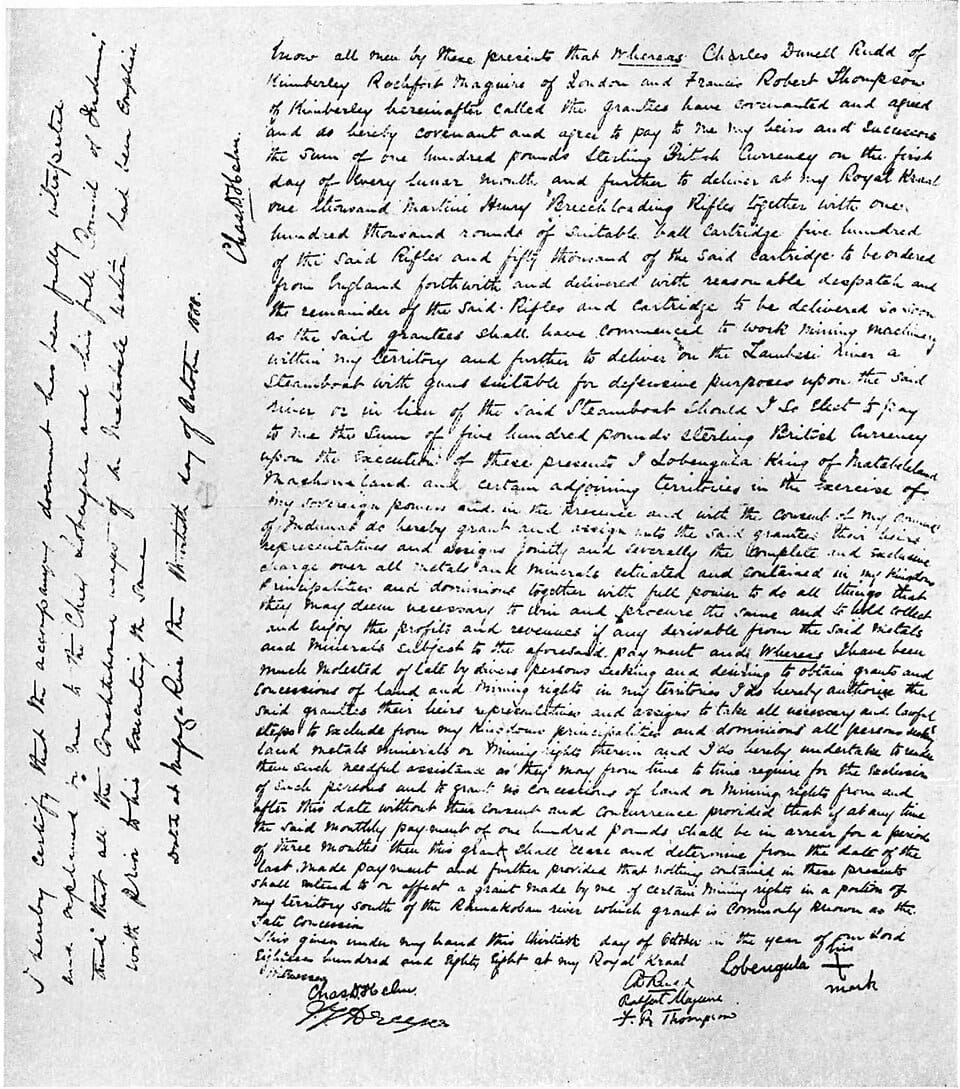
It strikes me that none of our rights as social media users mean diddly if they don't distil into terms that protect our interests. Case in point: the constant flurry of updated terms and conditions I've fielded from pretty much every social platform I have a live profile on of late. These are T's & C's which I'm embarrassed to admit I've given far less care to sense-checking than King Lobengula gave the concession he eventually signed after considerable deliberation.
He's often simplistically depicted as an illiterate native hoodwinked by savvy operators. A closer reading of history suggests a thoughtful monarch who did in fact apply checks and balances to his dealings with the various domestic and international stakeholders vying for footholds in his domain, not least the Boers and the British.
Nevertheless, by the time King Lobengula tried to repudiate the concession, it was too late to stop the machinery railroading his kingdom (pun intended) as part of Rhodes's grander plot to claim everything from the Cape to Cairo for himself (and the British Crown).
In July, Meta pulled an Instagram feature, built on its new Muse Image AI tool, that let anyone generate pictures from other people's public accounts. Launched on a Tuesday, it was gone by Friday. Public accounts had been opted in by default via presumed consent à la the Rudd Concession's sweeping fine print.
Unlike King Lobengula's ill-fated attempts to annul his pact with Rudd & Co, the Instagram feature was reversed. The reversal took influential and suitably incentivised talent agencies such as the Los Angeles-headquartered Creative Artists Agency (CAA) calling on Meta to make protection the default, and the Screen Actors Guild–American Federation of Television and Radio Artists (SAG-AFTRA) demanding a "clear and conspicuous opt-in".
It appears successful repudiation hinges, at least in part, on whether you have actual agency and/or an agent with sufficient clout to push back.
In August, to settle claims over teen social media addiction, Meta agreed to pay a coalition of US states and territories at least USD 12.1 billion over ten years, rising to USD 17.1 billion if rival platforms adopt the same safeguards. For context, Meta's 2025 revenue was about USD 201 billion. In light of that, USD 12.1 billion could well be viewed as a stipend of sorts.
As it happens, on 13 August 1893, King Lobengula refused his monthly £100 allowance. He found it reprehensible, a token of trickery, calling it "the price of my blood".
Once King Lobengula had made his mark, Rudd, Maguire and Thompson signed, and Maguire reportedly turned to Thompson and said: "Thompson, this is the epoch of our lives." He wasn't wrong. Within a year, the concession underpinned a British royal charter for Rhodes's British South Africa Company. And the rest, as they say, is Rhodesia.
Hand the world’s least-equipped digital citizens a sellable title to their data, and you should fully expect institutions and captains of industry, flanked by expensive lawyers sporting stacks of legal paperwork, to show up first.
Dubious legalese tends to favour the well-heeled and the well-lawyered, and less so the everyday people who can actually read and understand what they’re signing, never mind those who can’t and/or don’t, but sign anyway. Notwithstanding, once ‘consent’ is documented, there’s rarely truly actionable recourse to overturn the terms.
Earlier this year I debated Mastodon and X in public with Professor Iginio Gagliardone. I'll grant this much now. The cautious pragmatism that sees me continue to participate on X, while resisting advocacy for the wholesale adoption of decentralised alternatives like Mastodon, may well stem from frustration with the tendency to reach for systemic, at-scale frameworks in answer to impossible questions – questions that ultimately turn on individual discernment, which, concentrated and distilled in corporate contexts, reduces to institutional conscience (or indeed the lack thereof).
At best, those frameworks offer imperfect answers. At worst, they introduce oppressive dynamics of their own.
 Andile Masuku
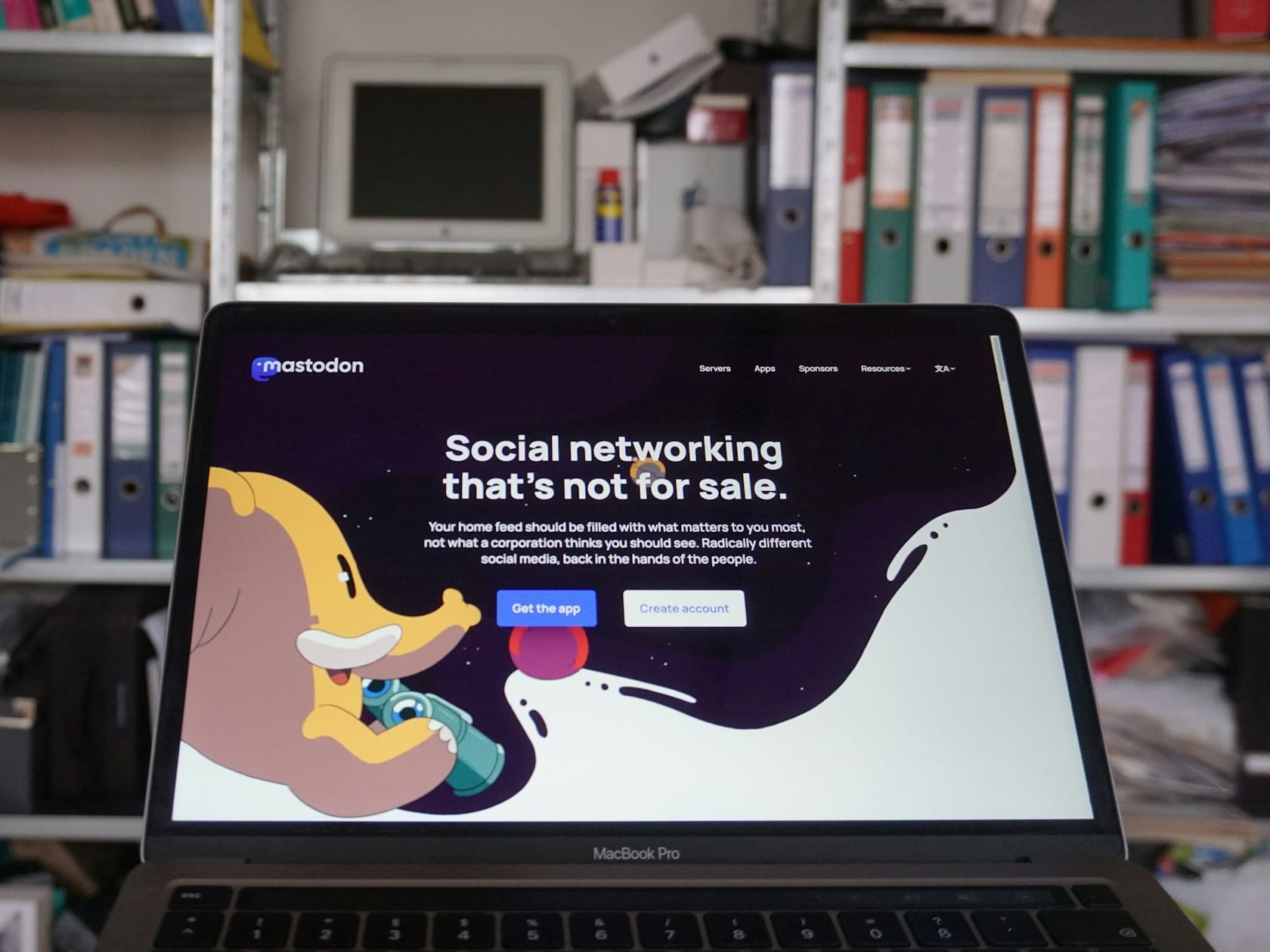
Kiin's pitch puts that discernment back with the individual, proposing that you list your content and price it, licence it on written terms, or simply default to selling nothing.
It will be interesting to compare their terms and conditions with those of Meta, LinkedIn, X and others when I'm eventually onboarded. I'll also be watching how their commercial model differs, and whether empowering users to own their IP proves sustainable.
Editorial Note: A version of this opinion editorial was first published by Business Report on 19 October 2026.