
The Trajectory Africa Distilled #07: The Asset Intensity Question in Digital Commerce
The market needs African B2B e-commerce to be asset-heavy, but the venture money was raised for asset-light.


Hello, Everyone!
With most of my fintech sensemaking complete (for now), it's time to focus on digital commerce.
To recap, I did deep dives on fintech and digital commerce and logistics for parts 1 and 2 of a podcast series called The Engine of African Venture: A Return to First Principles, on the underlying hypothesis that these sectors should drive the bulk of VC opportunities in Africa.
The inspiration for that assumption has multiple sources. Three of the six core principles I distilled from The Trajectory Africa's inaugural series highlighted the opportunity in digitalising African economies, investing in fintech as enabling infrastructure for these economies, and funding and supplying SMEs. In other words: fintech, digital commerce, and logistics.
 Tayo Akinyemi
Further, Olugbenga Agboola, Co-founder and CEO of Flutterwave, explained his belief that "there are three major pillars that can help Africa to leapfrog"—payments, commerce, and logistics—during a panel about the US's role in supporting inclusive digital transformation in Africa, hosted by the Carnegie Africa Program in 2022.
Hearing that felt like validation for my direction of travel. And the pod supplied its own “aha” moments: Abraham Augustine argued that payment rails have little utility without commercial activity passing through them, Emeka Ajene pushed back to suggest that infrastructure incentivises investment, and Samora Kariuki linked the volume of trade to the size of an economy.
So, whether you side with the chicken, the egg, or the omelette, it's pretty clear that financial infrastructure (built on and through technology) and trade both matter.
Parsing the digital commerce opportunity presented a bit of a conundrum, though. Principle #5 from the first podcast series seemed to provide a clear signal: "SMEs power tech startups by buying from them, and funding and supplying SMEs is a VC-scale opportunity." But this didn't jibe with the arc of reporting on the sector after its initial heralding, as business model challenges at companies like Alerzo and MarketForce emerged, along with Sabi's recent pivot.
It seemed like theory meeting practice in an uncomfortable way. So, I dived in to do what I do (or what I try to do, anyway)—distil the core logic and fundamentals, starting with what I heard from 12 brilliant founders and investors on what makes digital commerce opportunities tick. The caveat is that my conceptualisation of digital commerce is dominated by B2B e-commerce, or the supplying, financing, etc. of informal retailers.
There's more to the story than this, clearly, but most of my conversations and insights relate to this particular flavour of digital commerce.
 Tayo Akinyemi
Replacement, augmentation or something in between
An operational tension seems to characterise this segment—the decision to replace parts of "informal" supply chains or augment them. Replacement is an "asset-heavy" strategy that connects supply from brands (also known as manufacturers and importers) directly to retailers, cutting out distributors and wholesalers as "middlemen" and capturing a percentage of their margin for doing so. It requires inserting technology-enabled assets to take over those intermediary functions.
Augmentation is an "asset-light" strategy that delivers value to all supply chain actors instead, working with partners to handle logistics (thereby eschewing asset ownership) and capturing a portion of the surplus created. The choice reflects a founder's point of view on the market being served. In a more mature one like Nigeria, there are probably enough informal logistics players that can serve as responsive, high-quality distribution partners if given proper incentives, access to finance and delivery jobs like OmniRetail provides.
In less developed markets like Tanzania, those partners aren't readily available, and if you can't find partners who deliver high-quality, timely service, you have to do it yourself.
A third approach, asset efficiency, centres on the flexible deployment of hard-working assets. Sidy Niang and Jessica Long, Co-founders of Maad, a retail platform connecting FMCG brands and retailers in Senegal, described experimenting to discover the right configuration of assets. In the early stages of a company, when there are lots of "unknown unknowns" (sandy roads during certain times of year, for example), testing different types of trucks and warehouse pallet setups is the only way to learn which investments produce the most revenue relative to their cost.
Each approach comes with its own enabling conditions. On the asset-light side, one key is incentive alignment. On the Building the Future podcast with Dotun Olowoporoku (Managing Partner of Ventures Platform), and Deepankar Rustagi (CEO of OmniRetail), described how successful third-party logistics (3PL) relationships depend on performance monitoring on the platform. Asset ownership is supposed to buy control, so if you depend on partners to hit your delivery KPIs, incentives have to secure the alignment that ownership would have.
On the asset-heavy side, two conditions are really important. The first is revenue assurance. As Kikonde Mwatela, Co-founder and CEO of Exodus Mobility (and former COO of Twiga), explained, if you plan the production side of your operations well, the main challenge becomes whether you sell what you planned to sell. Missed deliveries, returned products, and unpaid orders are expensive to diagnose and fix when margins are thin.
The second is customers' willingness to pay for the level of service the assets enable. Firas Ahmad, Group CEO and Co-founder of Sarafu, a B2B e-commerce platform in Tanzania, worked out how to think about this. If the market's third-party providers offer service level x, and your product delivers service level y, the difference costs money. More than 7,000 shops order from Sarafu monthly because they're willing to pay a premium. Customers who weren’t prepared to cough up churned when prices rose to match the value proposition.
Assets the market wants that VC won't fund
Underlying a strategic choice about asset intensity is a difficult reality Lydia Idem, COO of LoftyInc Capital, named plainly. B2B e-commerce businesses need assets to succeed (think trying to build Amazon with no postal service), but investors don't necessarily want to fund them. In her words:
I think that startups actually want to be more asset-heavy than they are, but they understand that VC doesn't want to fund that... What I've seen is that [companies] pivot to go asset-heavy because the market is requiring it. You can't be a pure digital play quite yet. Then you'll see companies try to pivot back because they just don't have the money to adequately fund what they actually need to be successful... The market is requiring you to become asset-heavy and you got funding for an asset-light model. I think we have to recalibrate as investors to understand how much heaviness actually needs to be in a business model for it to be successful.
In short, founders pitch and build asset-light models, all while trying to manage an unstable equilibrium between the needs of the market and those of investors.
Why "pure play" B2B e-commerce struggles
On the business model side, one message came through clearly across multiple conversations. It's very difficult to make a standalone B2B e-commerce business work. Some useful context comes from the three business archetypes that Anu Adedoyin Adasolum, CEO of Sabi, and Dotun Olowoporoku, discussed on the Building the Future podcast: 1) buy (goods) low and sell (them) high; 2) make processes more efficient; and 3) put more money into the pockets of whomever you're serving.
When I asked Stephen Deng, Co-founder and General Partner at DFS Lab, to weigh in, he argued that the third approach is the only compelling one, and it's earned through proficiency with the first two. In a free market, trading margin gets competed away and process efficiencies eventually become the standard. But companies that master both create real value. Retailers make more money when startups sell goods to them more cheaply and more accessibly.
The trouble is what happened when VC-fuelled growth met commodities. As Firas recounts:
"When all this venture capital poured into the B2B e-commerce space in East Africa, about 2021, 2022—I think it was a total of half a billion dollars... What we saw after that funding round were these big gross merchandise value numbers... Most of those sales were commodities. And when I talk about commodities, particularly in the FMCG space, I'm talking about three products: flour, sugar, and oil... The informal market has found a way to sell these commodity products at a relatively inexpensive price without…a lot of inefficiency... So, building a business on a zero-margin value distribution platform is not likely to succeed."
In other words, these companies earned the same slim margins wholesalers do while carrying technology, logistics, back office, and people costs that wholesalers don't. The Silicon Valley playbook (acquire customers at a deficit, monetise them later) doesn't hold when the products are zero-margin and available everywhere.
 Tayo Akinyemi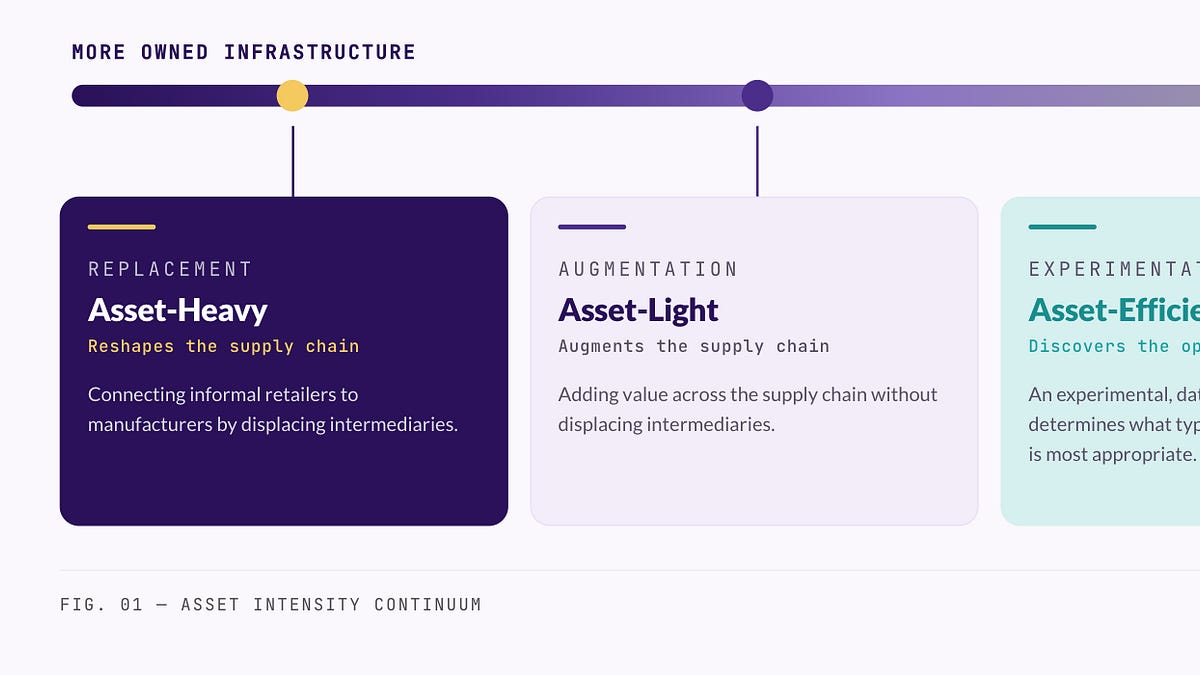
Diversified revenue to the rescue?
Cultivating multiple revenue streams seemed to be the common response to the pure play business model problem. Maad's founders note that even Amazon and Alibaba don't run standalone e-commerce businesses, and they've mirrored Amazon's service lines.
Most of Maad's net revenue comes from trading (buying products from manufacturers at a discount, or importing them, and selling to retailers at a higher margin). They also make money from rebates negotiated for selling volumes of product, and advertising revenue from brands paying to promote products through Maad's digitised network. Notably, the trading model only works if retailers order more than commodities, so Maad limits how many staples can be ordered on its platform and organises its loyalty programme around non-commodity purchases.
Sarafu takes an ecosystem approach. This means they sell mostly branded goods to retailers who pay a premium (8-9% margin) for reliable supply, processing high volumes of small payments through its sister company, AzamPay. They also manage logistics for other companies. It's worth noting that their trading business deliberately serves retailers at a location disadvantage, beyond the regular routes of brands and distributors. Those shops willingly pay more for trustworthy, convenient access to inventory.
And fintech platform Chari uses e-commerce as a "Trojan horse" to acquire merchants, through whom it delivers and monetises fintech services. This includes charging fees on money movement and transactions on Chari-issued cards, and earning interest on merchants' custodian accounts as well as a percentage of the value-added services merchants sell.
But Lydia offers two counterpoints to the “fintech as business model fixer” strategy that are worth considering.
First, attaching fintech to a business model doesn't automatically rescue the margins. Partnering for payment processing means sharing margin with a bank or fintech, and acquiring your own licence is a sizeable investment that may not be the best use of capital.
Second, disciplined focus is an asset. Adding services early in a company's life usually signals that the core model isn't growing fast enough, and the businesses that achieve massive success tend to stay laser-focused on a singular business model until profitability, a critical mass of users, or very low churn earns them the room to experiment.
Navigating last mile costs
There's a case to be made that augmenting supply chains preserves margin. If you deliver value to everyone in the chain, and help those players grow their revenues, they have more money to spend on your platform. But even then, you're still an intermediary, and both sides can squeeze you. Brands can raise the prices of the goods you resell, and retailers can demand lower prices to incentivise their purchases.
On the cost side, the last mile is what breaks business models. As the Maad founders explained, of the 6-6.5%+ margin Maad earns, most is eaten by last mile costs, followed by warehousing and fuel. That's why operational excellence (on-time deliveries that meet customer expectations) isn't a nice-to-have. Meeting delivery KPIs is what enables Maad to cover its logistics distribution costs.
Sarafu attacks the same problem by optimising routes, driver behaviour, and warehouse placement, and its experiments with electric vehicles cut delivery costs by 50-60% through lower maintenance and fuel costs.
When form must meet function
I started this learning journey assuming digital commerce had characteristics well-suited to VC, at least as it's currently practised. But the infrastructure gaps common to most African markets seem to require assets to a degree that this iteration of the model isn't built to accommodate.
That has two practical implications. The first is patient capital. Because these aren't pure digital plays, adoption and valuation growth take longer. As Lydia notes, some managers are discussing 12-15 year funds, and US VCs have already moved beyond the typical 10-year fund life. The second is debt. Equity is a poor fit for financing assets, but startups often can't get loans because they lack credit history (while they’re trying to acquire the assets that would serve as collateral).
Meanwhile, VCs don't want to pay for assets. But even if they did, equity financing is insufficient to fund the level of assets these companies need. In short, the ecosystem needs more debt vehicles—private credit, venture debt, and the like. Noting that, according to Stephen Deng, Co-founder & General Partner at DFS, debt made up 42% of funding to African startups in 2025.
As Lydia put it:
"We're seeing companies that have raised tens of millions of dollars go out of business because they need the assets, ultimately, for the business model to be successful. [But] if they don’t get the traction to get to a growth stage fast enough, they’re going to fail. [And] what we’re finding is the reason why these companies are failing is they can’t get the valuations. They can’t get the valuations because their revenue isn’t growing, or it’s not growing fast enough to justify a high valuation. And no VC wants to invest in a company where they know the founders are going to be heavily diluted. The incentive is no longer there."
The extreme TL;DR for B2B e-commerce models is if you're missing physical infrastructure, you probably need assets. If you need assets, then you also need debt financing. All of that means slower growth until it doesn't.
Coming up...
In the next piece, I'll share what I’ve learned about another type of digital commerce model—asset zero, requiring no assets at all. If you've got comments or questions about today's article, reach me at tayo@queryinsights.co.
Till the next one...
Tayo