
OP-ED - Rug tape versus immortality. Shaking a fist at death, sensibly.
Bryan Johnson's incurable disease diagnosis triggered global glee. Meanwhile, the actuaries quantifying longer lives have landed on a $5.8 trillion case for grab bars, walking and hearing aids. Who gets to age well, and what does it actually cost?

"The world wants me to die."
That was Bryan Johnson this weekend, the polarising American millionaire who has made it his life's purpose to not die. As in, not ever. And to spend his substantial fortune backing that mission.
He was taking stock of the reaction to news of his incurable autoimmune gastritis diagnosis. By his own tally, 1,900 articles appeared in a matter of days, and while many people were saddened, "joy dominated the commentary". He reckons humanity needs its death-challengers to fail. He placed himself in the archetypal company of Gilgamesh, Asclepius, and yes, even Jesus, which went about as well as you'd expect.
The world wants me to die.
— Bryan Johnson (@bryan_johnson) July 12, 2026
My incurable disease diagnosis became global news. It was omnipresent on social media and 1,900 articles were written in a matter of days.
Many were saddened.
However, joy dominated the commentary.
People pointed to schadenfreude, the pleasure…
To be clear, I don't subscribe to even the speculative notion that humans can cheat death through their own ingenuity. But I do feel that the gleeful response to news that Johnson is (like the rest of us) on track to his eventual demise is mean-spirited and wholly unwarranted.
I am also, however, acutely sensitive to the existential injustice and indignity of ageing, and empathise with the desire to shake a fist at death... and perhaps do one better, steward the fleeting years of life we’re all granted as conscientiously as possible.
I've been mulling this over since the iFHP Biennial in London last month, the same gathering that produced my "money room" dispatch a fortnight ago. A fireside session on insurance in the longevity era stands out. It was presented by Andrew Matthews, an actuary at Finity Consulting, and Joseph Lu, actuary and director of longevity science at Legal & General, the UK financial services group and one of the world's largest managers of pension and annuity assets. Their framing suggests that longevity is becoming less a mortality challenge and more a health span, frailty, care and financing challenge. Essentially, the question is shifting from how long we live to how well, and who pays.
 Andile Masuku
Lu contributed to a World Economic Forum report published in June, The Longevity Dividend, which puts spectacular numbers to that shift. Its headline finding is that three relatively modest, low-tech interventions could save the world's healthcare systems upwards of USD 5.8 trillion and unlock another USD 645 billion in productivity by 2040.
Those three turn out to be 1) fall-proofing homes with rug tape, grab bars and better lighting, 2) two extra hours of moderate physical activity a week, and 3) wider access to hearing aids, which, by delaying dementia onset, could apparently prevent 2.4 million cases. So, no whizzy gene therapy, no plasma transfusions… It’s basic environmental safety, a little more exercise and hearing aids. That’s it.
These findings are especially encouraging to contemplate as a helpful alternative to the longevity experiments being trialled by the likes of Johnson, which are prohibitively costly and out of reach for most people curating futures in Africa. In any case, they are also largely impractical and incongruent with the continent's ideological leanings and lived realities.
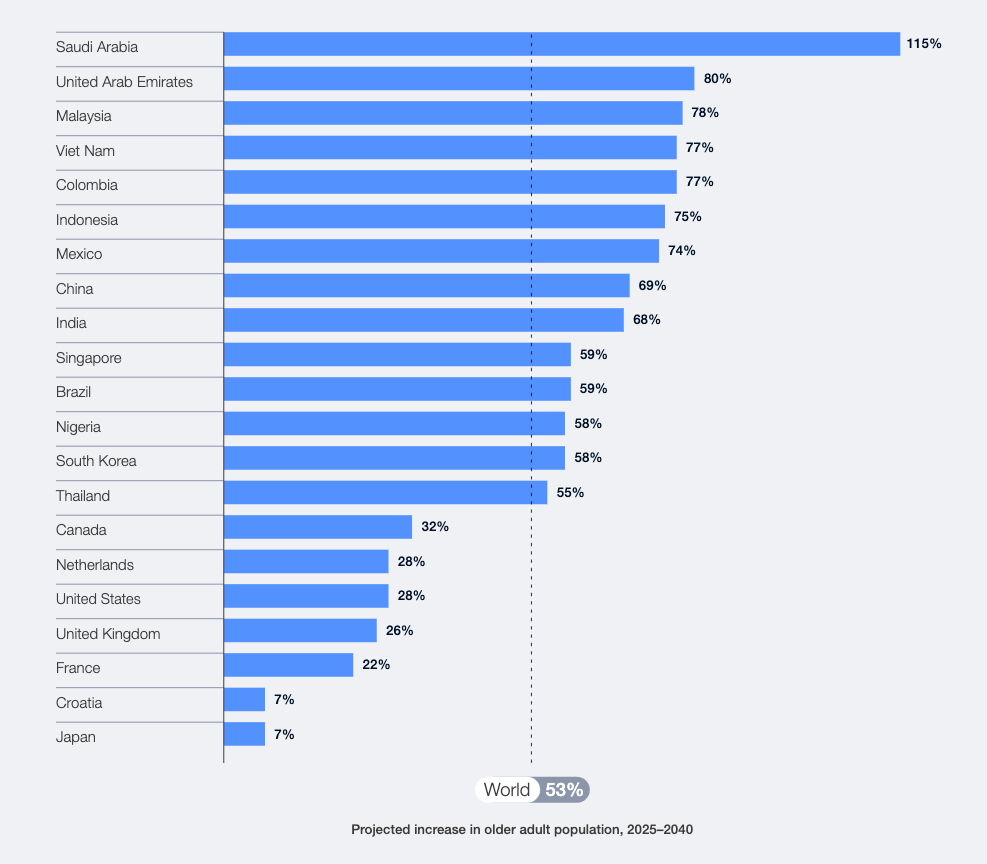
The report holds that demographic pressure is not a rich-world story, with the fastest proportional growth in over-65 populations between now and 2040 projected to happen in countries we still describe as "young", Nigeria among them. However, on the report's own numbers, two of the three interventions pay back weakest in Nigeria within the window, partly because Nigerians already move more than the sedentary rich world, and partly because a USD 1,500 hearing aid is a very different proposition against Lagos wages than against Amsterdam ones. The falls-prevention case travels well, while the rest is a bet on getting ahead of a transition that hasn't happened yet.
It struck me, too, sitting in London, that the Western longevity debate carries a peculiar counterpoint. There’s a growing wave of activism to legalise assisted dying, so that people might escape the indignities of being (elderly and) painfully frail, (elderly and) unwell, or some cruel mix of the two. Even as one part of the world is engineering more life, the other is legislating exits from it.
Lu grew up in what he calls the "developing world" and remains passionate about it. In correspondence after the conference, he sketched a thesis that speaks to the affordability gap directly. Think developing countries actively pursuing equal, win-win partnerships with advanced economies to build out their healthcare economy-systems.
The developing world brings land-use, customers, workers and systems to the table to meet inflows of capital and technology. Capital and tech providers are rewarded with wealth; the home country with health, wealth and, eventually, the know-how itself. It's one contribution to the broader theatre of ideas for straightening what is crooked and counting what is lacking.
In a later post Johnson said that he was emboldened by the diagnosis, which he considers a mere wrinkle in his undeterred mission to not die, ever. But if the actuaries are right, the real allies of longer, better lives are conscientious adopters of unglamorous lifestyle updates few, if any, are falling over themselves to make a documentary about.
Editorial Note: A version of this opinion editorial was first published by Business Report on 14 July 2026.